
TBD stands for “To Be Determined.” It means something hasn’t been decided yet. The person is essentially saying, “I don’t have an answer right now, but one is coming.”
That’s it. Simple, right? But there’s actually a lot more to this little acronym than most people realize — especially when you start using it in different contexts like sports, jobs, medical settings, or relationships. Let’s break it all down.
The Real Meaning of TBD (And Why It’s Everywhere)
TBD — To Be Determined — is one of those acronyms that jumped from professional documents straight into everyday texting without anyone really noticing. You’ll see it in a group chat, on a sports schedule, in a job listing, and sometimes even on a hospital report.
The core idea is always the same: a decision or detail is pending. Nobody knows the answer yet, or someone hasn’t confirmed it. It’s a placeholder — a way of saying “this space will be filled in later.”
Some people also use TBD to mean “To Be Decided” or “To Be Discussed.” These three variations are all correct and widely accepted. The meaning shifts very slightly depending on context, but the feeling is identical — not yet confirmed.
You might also occasionally see TBA (To Be Announced), which is close in meaning but usually refers to something that’s ready but just hasn’t been shared publicly yet. TBD leans more toward “we genuinely don’t know yet.”
Where Did TBD Come From?
Before smartphones and group chats, TBD lived mostly in business memos, project plans, and event schedules. Office workers used it on spreadsheets and reports when a meeting time or budget number hadn’t been locked in. It was purely professional shorthand.
As texting became mainstream in the early 2000s, people started carrying office habits into their personal lives. Acronyms like TBD, FYI, ASAP, and ETA migrated from emails to SMS messages. By the time social media exploded, TBD was already a natural part of digital vocabulary.
Today, Gen Z and millennials use it casually without thinking about its corporate roots. You’ll see it on Instagram stories, Twitter/X posts, Discord servers, and TikTok comment sections. The acronym has fully crossed over — it belongs to everyone now.
TBD in Everyday Texts and Social Media
Here’s where it gets fun. People use TBD in surprisingly creative ways in everyday conversation. Let’s look at how it actually shows up:
In a group chat: “Are we still going to the mall Saturday?” “TBD — waiting to see if my cousin visits.”
On Instagram: Someone posts a teaser photo with the caption: “Something exciting is coming… 👀 Date: TBD”
On Twitter/X: A creator announces a new video series with: “Episode 1 drops next week. Episode 2: TBD 🎬”
In all these cases, TBD acts as a conversational pause button. It’s not a “no.” It’s not a “yes.” It’s a “hold on.” And in fast-moving digital conversations, that’s actually a really useful thing to say.
TBD Meaning in Different Fields — A Contextual Breakdown
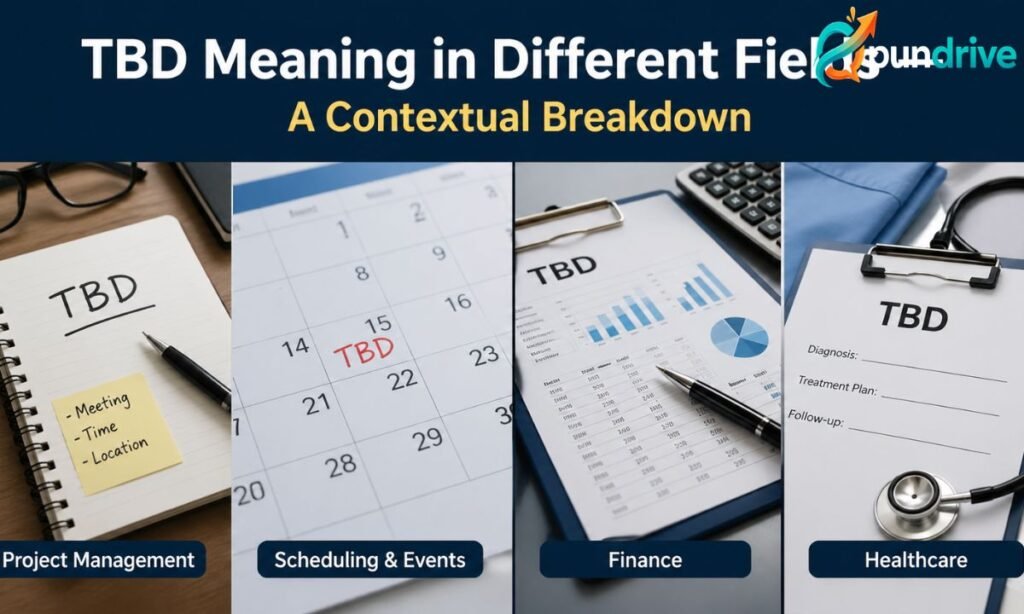
This is where things get genuinely interesting. TBD doesn’t always mean exactly the same thing everywhere. Context matters a lot.
TBD in Cricket
If you follow cricket — especially international fixtures or IPL schedules — you’ve definitely seen “TBD” next to a team or player name. In cricket, TBD typically appears when:
- A playing XI hasn’t been announced yet
- A venue or match date is still being finalized
- A replacement player hasn’t been confirmed for an injured squad member
For example, a fantasy cricket app might list a batting spot as “TBD” until the official team is released two hours before the match. It signals to fans: don’t make decisions yet, wait for confirmation.
TBD in Gaming
Gamers see TBD constantly — in patch notes, release windows, and tournament brackets. A game developer might announce a new character with a release date of “TBD Q3 2026,” meaning it’s coming sometime in that quarter but the exact date isn’t locked yet.
In esports tournaments, TBD appears in brackets when teams haven’t played their qualifying matches yet. The slot exists, the opponent doesn’t. It keeps the structure visible without false information.
There’s also a cultural layer here — gaming communities sometimes use “TBD” sarcastically. If a highly anticipated game keeps getting delayed, fans might joke: “Release date: TBD (aka never).”
TBD in Job Listings
Seeing TBD in a job posting can feel confusing — or even suspicious. But it’s usually just honest transparency. Common places TBD appears in job ads:
- Salary: TBD — The company negotiates based on experience
- Start date: TBD — They’re still hiring and haven’t set a timeline
- Location: TBD — Remote/hybrid/in-office is still being decided
If you see “Salary: TBD,” it doesn’t necessarily mean lowball offers — it often means they want to evaluate the candidate first. However, it’s completely fair to ask for a range during the interview process. Don’t let TBD scare you away from applying.
TBD in Medical Contexts
This is perhaps the most serious context where TBD appears. In healthcare and medical documentation, TBD usually refers to “To Be Determined” in the context of a diagnosis, treatment plan, or test result that hasn’t been confirmed yet.
For example, a doctor might write “diagnosis: TBD pending lab results” in a preliminary report. This means the patient’s condition hasn’t been officially confirmed — more information is needed before a definitive conclusion.
In medical billing and insurance, TBD can also appear next to coverage amounts or procedure codes that are still being processed. If you see TBD on a medical document, it almost always means: “don’t panic — this is a placeholder.”
TBD in Relationships
Ah, here’s where it gets emotionally complex. When someone says “TBD” about a relationship — “Are we exclusive?” “TBD” — it can feel like emotional limbo.
In relationship conversations, TBD often signals:
- Someone isn’t ready to commit to a label
- The relationship is progressing but both people want more time
- Plans are being made but feelings are still being sorted out
It’s not always a red flag. Sometimes TBD in a relationship context is healthy — it shows someone is being honest rather than rushing into something they’re not sure about. That said, if TBD becomes a permanent answer to serious questions, that’s worth a direct conversation.
TBD in Football
Whether you follow American football (NFL) or soccer, TBD pops up in fixture lists, depth charts, and transfer windows regularly.
In the NFL, TBD next to a player’s status means their game-day participation is uncertain — often due to injury reports. A head coach saying “his status for Sunday is TBD” is sports-speak for: “we’re monitoring him, no guarantees.”
In soccer, TBD appears frequently during transfer windows when a player’s destination hasn’t been confirmed, or when a match venue is subject to change based on ticket sales or broadcasting agreements.
Also Read This:OTW Meaning in Text: What OTW Means in Chat, Social Media & Online Messaging in 2026
A Section You Won’t Find on Most Other Sites: The Psychology of Using TBD
Here’s something rarely discussed — why people choose to say TBD rather than just saying “I don’t know.”
There’s a subtle but real difference. “I don’t know” can feel like a dead end. It puts the responsibility back on the listener with no forward momentum. TBD, on the other hand, implies continuity. It says: something is in motion, an answer is coming, this isn’t over.
In professional settings, TBD protects credibility. If a manager says “I don’t know when the budget will be approved,” it might sound disorganized. But “the budget approval timeline is TBD” sounds planned and in-process — even if the situation is identical.
In personal conversations, people use TBD to buy time without shutting down a conversation. It’s gentler than “no” and more honest than a fake “yes.” Understanding this psychology helps you read the room when someone says TBD to you.
Other Hidden Meanings of TBD (You Didn’t Expect These)
Outside mainstream usage, TBD carries a few niche or alternative meanings:
- Total Body Deficit — used in some clinical nutrition and hydration contexts
- To Be Determined in legal contracts — refers to terms still under negotiation
- TBD (Tick-Borne Disease) — appears in medical literature when discussing Lyme disease and similar conditions transmitted by ticks
- The Breakdown — used by some music communities as shorthand for a specific song section
- In some online communities, TBD is used humorously as “Totally Bad Decision” — though this is slang, not standard
Related Acronyms Worth Knowing
Since you’re already using TBD, these closely related terms are worth having in your vocabulary:
| Acronym | Full Form | Best Used When |
| TBA | To Be Announced | Answer is ready, not yet public |
| TBC | To Be Confirmed | Needs final verification |
| WIP | Work in Progress | Something is actively being built |
| ETA | Estimated Time of Arrival | A timeline exists but isn’t exact |
| NGL | Not Gonna Lie | Casual honesty in conversation |
How to Respond When Someone Says TBD

Getting a TBD reply can feel awkward if you’re not sure what to do with it. Here’s how to handle it depending on context:
If it’s casual (plans, hangouts): Just say “okay, let me know!” — no pressure needed. TBD in this context usually means they’ll circle back soon.
If it’s about something important (a job offer, a contract, a commitment): It’s perfectly reasonable to ask for a timeline. Try: “No worries — when do you think you’ll know?” That keeps things friendly while setting an expectation.
If TBD keeps appearing in the same conversation: That might be worth a deeper talk. Repeated TBDs can sometimes signal avoidance, especially in personal relationships or negotiations.
If it’s on a public schedule (sports, events, travel): Just bookmark or follow the source. TBD on schedules almost always resolves — you just have to wait for an update.
Is TBD Professional Enough for Work?
Short answer: yes — with conditions.
TBD is widely accepted in professional communication, especially in emails, project management tools, Slack messages, and meeting agendas. It’s clean, clear, and universally understood. Using it saves time and avoids guesswork.
However, in formal documents — like client proposals, legal contracts, or executive presentations — consider replacing TBD with a more complete phrase: “The timeline will be confirmed following stakeholder review” reads more polished than just “TBD.”
In spoken meetings, saying “that’s still to be determined” is smoother than saying “TBD” out loud, which can feel clipped or dismissive.
Regional and Cultural Variations
TBD is primarily an English-language acronym, but its use has spread globally through American media, tech culture, and online platforms. Here’s how it varies:
In South Asian countries (including Pakistan and India), TBD is increasingly common in urban and professional settings, particularly in tech, media, and corporate environments. English-language abbreviations like TBD, TBA, and ETA are comfortably used in professional emails and social media.
In British English, TBC (To Be Confirmed) is sometimes preferred over TBD — they carry nearly identical meanings, but TBC has stronger roots in UK corporate culture.
In non-English-speaking countries, TBD is often used as-is on international platforms (YouTube, gaming, sports broadcasts) because it’s recognized globally. However, people may translate or explain it in their native language for local audiences.
Best Practices: Using TBD Without Confusion
A few simple guidelines to make sure TBD works for you, not against you:
Be specific when possible. If you know a rough timeframe, say it. “TBD — probably next week” is much more useful than just “TBD.”
Don’t use TBD as an escape hatch. If you’re avoiding making a decision, people will notice. TBD works best when it’s genuinely true.
Follow up. If you said TBD, own the follow-through. Come back with an actual answer once you have one. Nothing erodes trust faster than a TBD that never gets resolved.
In formal writing, spell it out. Especially in documents meant for people who may not be familiar with the acronym. “To be determined” is always clearer than assuming everyone knows the shorthand.
Frequently Asked Questions
What is the full form of TBD?
TBD stands for “To Be Determined” — though it can also mean “To Be Decided” or “To Be Discussed” depending on context.
Is TBD the same as TBA?
Not exactly — TBD means a decision hasn’t been made yet, while TBA means a decision exists but hasn’t been publicly announced.
Can I use TBD in a professional email?
Yes, TBD is acceptable in professional emails and workplace chats, though formal documents may benefit from the spelled-out phrase.
What does TBD mean in a job posting?
In job listings, TBD usually refers to salary, start date, or location details that haven’t been finalized by the employer yet.
What does TBD mean when texting someone?
In texting, TBD means the person isn’t sure yet — about plans, an answer, or a decision — and will confirm later.
Final Thoughts
TBD is one of those acronyms that sounds simple but quietly does a lot of heavy lifting in modern communication. Whether it appears on a cricket scorecard, inside a hospital report, in a job offer, or in a late-night group chat — it’s always saying the same thing at its core: we’re not there yet, but we will be.
Understanding TBD in context — not just in definition — is what separates people who communicate clearly from those who leave others guessing. Now that you know the full picture, you’re equipped to use it well, respond to it confidently, and recognize when it’s being used to genuinely hold space versus when it’s a polite way of saying “I’d rather not answer.”
The next time TBD shows up in your feed, your inbox, or your messages — you’ll know exactly what’s going on.
